The SACCO Amendment Bill: Series 3
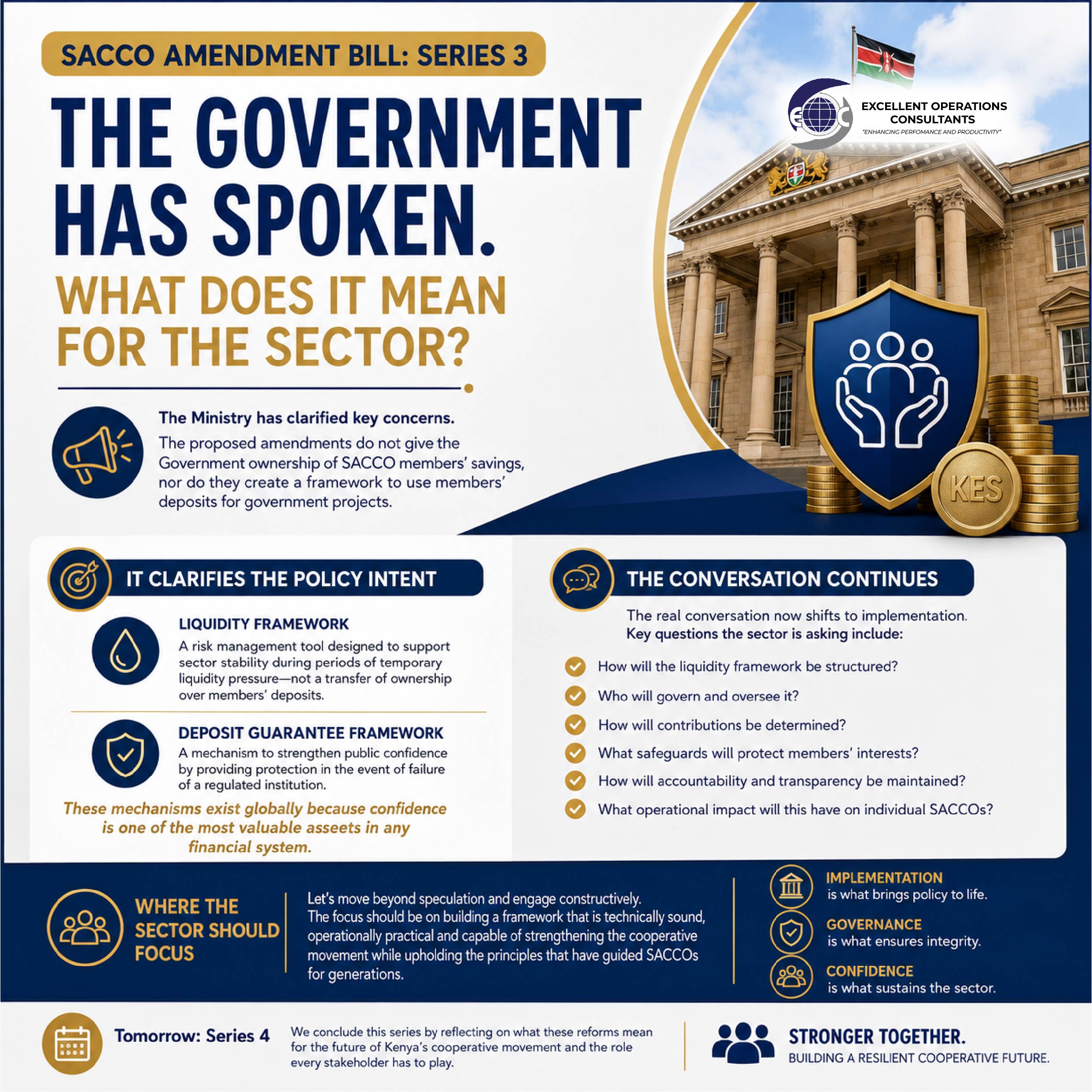
The Government Has Spoken. What Does It Mean for the Sector?
Over the past week, the proposed SACCO Amendment Bill has sparked one of the most significant policy discussions the cooperative sector has witnessed in recent years.
The debate has been constructive. At the same time, it has highlighted the level of uncertainty that naturally arises whenever proposed reforms touch on members’ savings, governance structures, and the future of SACCOs.
Following growing public concern, the Ministry of Cooperatives and MSMEs Development, through the Principal Secretary, issued a clarification addressing one of the issues that had generated the greatest public attention.
The message was clear.
The proposed amendments do not give the Government ownership of SACCO members’ savings, nor do they establish a framework through which members’ deposits would be used to finance government development projects.
For many stakeholders, this clarification was significant because it addressed the narrative that had dominated much of the public conversation.
However, an equally important question remains:
What does this clarification actually mean for the cooperative sector?
It Clarifies the Policy Intent
From EOC’s analysis, the Government’s statement helps distinguish between ownership of members’ funds and sector-wide financial stability mechanisms.
These concepts are often discussed interchangeably, yet they serve fundamentally different purposes.
A liquidity management framework is generally intended to strengthen the resilience of financial institutions during periods of temporary liquidity pressure. Its primary objective is to support sector stability—not to transfer ownership or control of members’ deposits.
Similarly, a deposit guarantee framework is designed to enhance public confidence by providing a level of protection in the event that a regulated institution experiences financial distress or failure.
Mechanisms of this nature exist in various forms across financial systems worldwide because public confidence remains one of the most valuable assets any financial institution can possess.
The Clarification Does Not End the Conversation
While the Government’s clarification addresses one of the most widely discussed concerns, it should not be viewed as the conclusion of stakeholder engagement.
Rather, it marks the beginning of a more important phase of the discussion.
Across the sector, the conversation is now shifting from “What is the Government trying to do?” to “How will these proposals work in practice?”
Key implementation questions remain, including:
- How will the proposed liquidity framework be structured?
- Who will govern and oversee its operations?
- How will contributions be determined?
- What safeguards will protect members’ interests?
- How will accountability and transparency be maintained?
- What operational impact will the proposed framework have on individual SACCOs?
These are practical implementation questions, and they deserve the same level of attention as the policy proposals themselves.
Where the Sector Should Focus
At EOC, we believe the cooperative movement now has an opportunity to move beyond speculation and toward informed, constructive engagement.
The discussion should no longer be driven solely by headlines or social media commentary. Instead, attention should now focus on whether the proposed framework is technically sound, operationally practical, and capable of strengthening the cooperative sector while preserving the core principles that have guided SACCOs for generations.
Ultimately, the success of any reform is not measured by its intentions alone.
It is measured by the quality of its implementation.
It is measured by the strength of its governance.
And above all, it is measured by the confidence it inspires among the members and institutions it is intended to serve.
Tomorrow, we conclude this series by reflecting on what these proposed reforms could mean for the future of Kenya’s cooperative movement and the role every stakeholder can play in shaping that future.
#SACCOAmendmentBill #SACCOs #Cooperatives #Governance #RiskManagement #FinancialInclusion #MemberProtection #KenyaCooperatives #EOC

Recent Posts
The SACCO Amendment Bill: Series 4: Looking Beyond the Bill
The SACCO Amendment Bill: Series 3