The SACCO Amendment Bill: Series 2
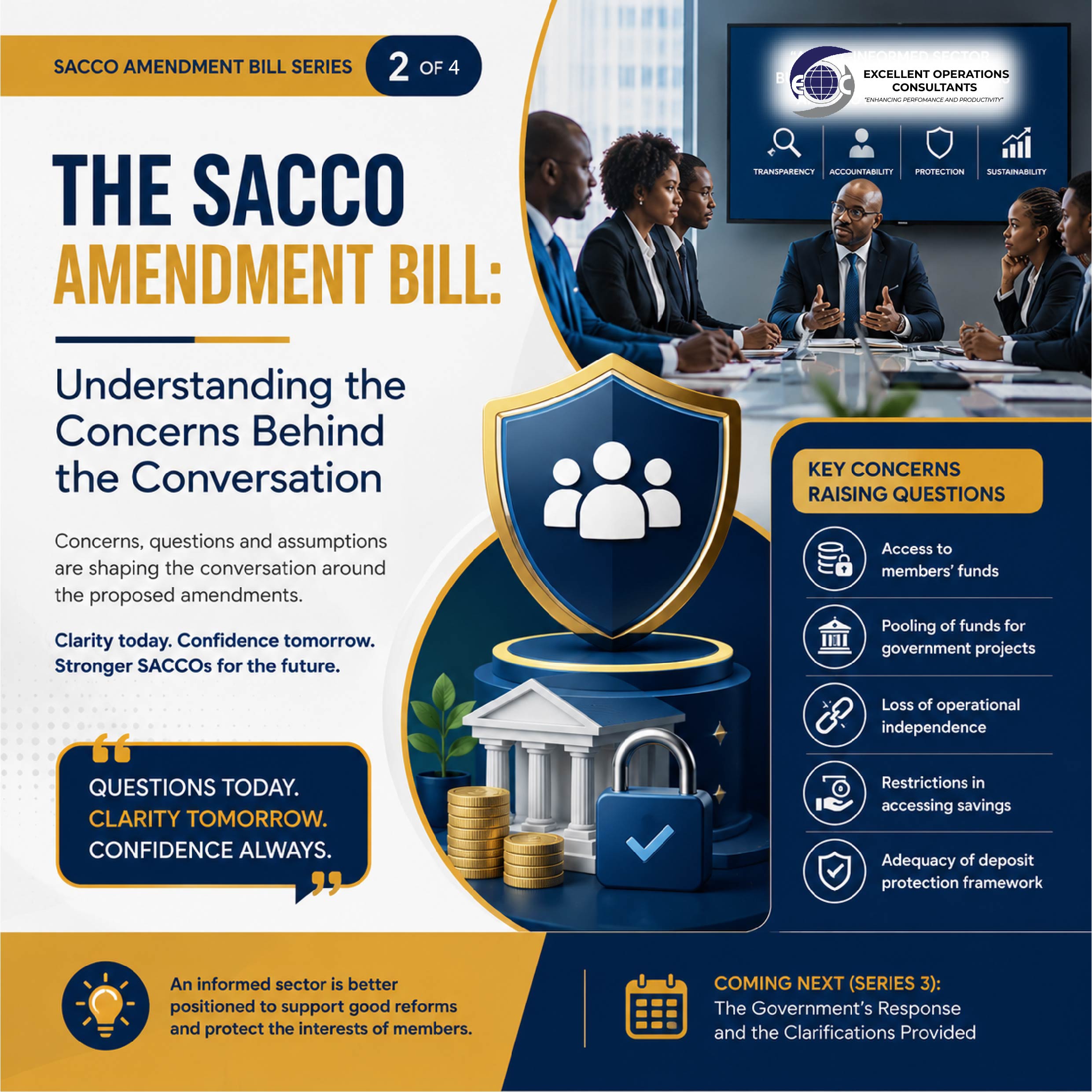
Understanding the Concerns Behind the Conversation
Yesterday, we explored why the proposed amendments to Kenya’s SACCO legal framework have emerged at this critical stage in the evolution of the cooperative movement.
Today, we shift our focus to the conversation surrounding the Bill itself.
At Excellent Operations Consultants (EOC), one thing has become increasingly evident through our engagements with SACCOs across the country: the debate is no longer centred solely on the provisions of the Bill. It has evolved into a broader discussion about trust, confidence, transparency, and understanding.
In recent weeks, SACCO leaders, board members, employees, and members have been exposed to a wide range of information, opinions, interpretations, and predictions. While some discussions are grounded in the actual provisions of the proposed legislation, others are based on assumptions or differing interpretations of what the reforms might mean in practice.
As a result, many stakeholders are finding it increasingly difficult to distinguish the proposed legislative changes from the narratives that have emerged around them.
Why Are People Concerned?
The concerns currently being expressed are not unique to Kenya’s SACCO sector. Across the world, reforms that touch on member savings, governance structures, financial oversight, or institutional autonomy naturally attract heightened public interest.
For SACCO members, these concerns are deeply personal.
Their savings are more than balances in an account—they represent school fees, home ownership dreams, retirement security, business investments, and years of disciplined financial commitment.
It is therefore understandable that any proposal perceived to affect these funds would receive careful scrutiny and generate significant public discussion.
The Key Concerns Emerging
Several issues have dominated conversations within the cooperative sector. Among the most common concerns are claims that:
- The Government could gain access to SACCO members’ funds.
- SACCO savings may be pooled or redirected to finance government development projects.
- SACCOs could lose a degree of their operational independence.
- Members may encounter restrictions when accessing their savings.
- The proposed deposit protection framework may not provide sufficient protection should a SACCO experience financial distress or institutional failure.
These concerns have gained traction because they touch the very foundation of the cooperative movement—member ownership, democratic control, and financial security.
What Is Driving These Perceptions?
From EOC’s perspective, much of the uncertainty stems from the introduction of concepts that are unfamiliar to many SACCO stakeholders.
Terms such as liquidity management frameworks, stabilisation mechanisms, and deposit guarantee systems are highly technical and can be difficult to interpret without sufficient context.
Without clear and accessible explanations, such concepts may be perceived as instruments of central control rather than mechanisms designed to strengthen financial stability and protect members.
This creates a gap between policy intent and public perception—and where that gap exists, misinformation can easily flourish.
Are All These Concerns Misconceptions?
Not necessarily.
In fact, many of the questions being raised are both legitimate and necessary. Constructive scrutiny is an essential part of developing effective legislation.
Some of the key questions stakeholders continue to ask include:
- How will the proposed liquidity management framework operate in practice?
- What safeguards will be in place to protect members’ savings?
- To what extent will SACCOs retain their operational autonomy?
- How will transparency, accountability, and good governance be maintained?
- Will the proposed member protection mechanisms be adequate should a SACCO become financially distressed?
These are not questions born out of resistance to reform. Rather, they reflect a sector seeking clarity, assurance, and confidence before embracing significant legislative change.
The Conversation the Sector Should Be Having
At Excellent Operations Consultants (EOC), we believe the national conversation should move beyond headlines, speculation, and social media sound bites.
The priority should not be choosing sides—it should be building a shared understanding among members, SACCO leaders, regulators, policymakers, and other stakeholders about:
- What is being proposed;
- Why the reforms are being introduced; and
- What the practical implications may be for SACCOs and their members.
A well-informed cooperative sector is better positioned to support meaningful reforms, challenge proposals where necessary, and safeguard the interests of millions of Kenyan members who depend on SACCOs for financial empowerment.
Tomorrow, in Series 3, we will examine the Government’s response to the concerns that have been raised and explore the official clarifications provided regarding the proposed amendments.
Follow Excellent Operations Consultants (EOC) as we continue unpacking the SACCO Amendment Bill through this educational series, providing balanced insights to help cooperative leaders and members make informed decisions.
#SACCOAmendmentBill #SACCOs #Cooperatives #Governance #MemberProtection #FinancialInclusion #RiskManagement #KenyaCooperatives #EOC

Recent Posts
The SACCO Amendment Bill: Series 4: Looking Beyond the Bill
The SACCO Amendment Bill: Series 3